

My Hearing PREM
My Hearing PREM
My Hearing PREM (Patient-Reported Experience Measure) is a questionnaire designed to capture the experience of adults living with hearing loss and receiving audiology care. Developed using rigorous research methods in partnership with people with hearing loss, audiologists and researchers, My Hearing PREM measures aspects of experience that matter most to patients: the emotional impact of hearing loss, experiences of communication, support from family and friends, and support received from audiologists. By providing a structured way for patients to share their experiences, My Hearing PREM helps audiologists gain a better understanding of how hearing loss is affecting an individual’s daily life and whether they feel supported throughout their audiology care.
At a service level, aggregated PREM data can be used to identify service strengths, highlight areas for improvement and support quality improvement initiatives (from September 2026, My Hearing PREM will be available on Auditbase with the function to run standardised PREM reports). Ultimately, My Hearing PREM supports audiology services to deliver person-centred and high-quality care.
My Hearing PREM (short and long form), manual and publications are freely available from the Aston University website: Access My Hearing PREM
Patient-Reported Experience Measures (PREMs) are structured questionnaires designed to capture patients’ perspectives on their health condition and healthcare experiences. They are distinct from Patient-Reported Outcome Measures (PROMs), which focus on health status or outcomes rather than the care process itself. Patient reported experience measures capture what it is like to live with the health condition, not just the things that someone can or cannot do because of it.
Patient experience of hearing loss has been extensively modelled from accounts of adults, of all ages, who describe what it is like to live with hearing loss and what makes a difference to living with hearing loss. For more information on the inductive model from which My Hearing PREMs are derived please see https://www.tandfonline.com/doi/full/10.1080/14992027.2024.2351037
For information on the narrative synthesis checking this model against the wider literature see: https://www.tandfonline.com/doi/full/10.1080/14992027.2025.2523902
Most people living with hearing loss will do so for a long period of time, often for the rest of their lives. The experience they have of their hearing loss may alter over time, even if their hearing loss does not. Rehabilitation in audiology is typically aimed at improving patient responses e.g. coping, with the hearing loss they have. This might include using hearing aids or other devices or attending communication or lip-reading groups. For some individuals it is helpful to work with a Hearing Therapist to come to terms with the hearing loss and discuss the impacts it has upon an individual’s life.
Regardless of the level or type of hearing loss, people will have a firsthand experience of it. This experience contributes to individual reactions and responses to both hearing loss and the treatment for hearing loss.
At a clinical level, individual practitioners may wish to record patient experiences to check that their interventions align with patient experiences. For example, patients who have clusters of negative experiences on the emotional factor may wish to tailor their interventions towards addressing emotional support. The individuals who express greater negative experiences of communication, may need tailored support to that factor. Furthermore, alongside specific and relevant patient reported outcome measures (PROMs) the PREM can capture the experience of the hearing loss over time.
At a service level managers will wish to know the typical profile of experiences held by their local clinical population. They will want to know whether their interventions improve experiences – even without creating change in hearing.
Commissioners want information to compare clinical services and ensure that the services they commission impact the experiences of people with hearing loss.
Information on how the My Hearing PREM was developed can be found here: https://onlinelibrary.wiley.com/doi/10.1111/hex.70088
Information on the reliability and validity testing of the My Hearing PREM can be found here: https://onlinelibrary.wiley.com/doi/10.1111/hex.70225
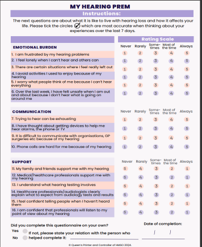
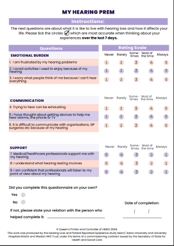
My Hearing PREM-16 is a valid and reliable tool that comprises three subscales (each reliable in their own right) that measure emotional burden of hearing loss, communication effects of hearing loss and social support experiences.
The My Hearing PREM-9 is a short form version that works as a whole measure to capture most (95%) of the variance amongst people’s experiences. The short form version cannot be used as individual subscales but as a whole measure. As it consists of 9 items it is slightly quicker to administer and useful for clinical settings.
When it works for you!
The My Hearing PREM includes both questions about patient experience that can be useful to plan care (questions relating to emotion and communication) and questions that capture support, including support from clinical services.
To measure individual and service experience
It might work best to ask patient to complete the communication and emotion questions in advance and the social support questions about clinical services after they have seen you e.g. before and after an assessment appointment. Alternatively, you could administer the measure after the initial assessment prior to fitting or intervention appointments.
Remember to obtain a reliable overall measure of experience you need to ask all the questions – this does not mean you need to ask them all at the same time necessarily.
For research purposes
The My Hearing PREMs will reliably measure patient experiences so long as the whole measure is completed. It may be required for the purposes of the study to complete all questions at the same time or alongside other measures.
Pre and post interventions
The My Hearing PREM is a reliable measure that capture people’s experiences at different time points. It may be a useful way to capture shifts in experience pre and post intervention. Remember to use Patient Reported Outcome Measures to capture treatment outcomes too.
The items on My Hearing PREM 16 and 9 are scored according to how often something is experienced over the last week. This means there is a categorical scale Always/ Most of the time/ Sometimes/Rarely/Never. Depending on whether the question is positively worded e.g. ‘I understand what hearing testing involves’ or negatively worded e.g. ‘I am frustrated by my hearing problems’ you will find the scale either reads Never-Always or Always-Never.
To enable you to calculate scores or input into Auditbase or other patient management software, or to produce reports or compare patients – we have proposed a numerical system to represent the category. For negatively worded items never =1, rarely = 2, sometimes = 3, most of the time = 4 and always =5. For positively worded items the scoring is reversed with always = 1 and never =5. The score for each item is proposed on our physical copies of the My Hearing PREM. This allows clinicians to simply add up a score for each factor (16 item) or provide one overall score of experience (9 item).
The numerical scores are intended to give an overall picture with some individuals scoring more highly than others, suggesting they may have higher need. However, it is important to look at what the scores relate to for everyone. The area where experience is better and worse may be more clinically meaningful than the overall score.
The items on My Hearing PREM 16 and 9 are scored according to how often something is experienced over the last week. This means there is a categorical scale Always/ Most of the time/ Sometimes/Rarely/Never. Depending on whether the question is positively worded e.g. ‘I understand what hearing testing involves’ or negatively worded e.g. ‘I am frustrated by my hearing problems’ you will find the scale either reads Never-Always or Always-Never.
Clinical sites have told us that using the My Hearing PREM was easiest when patients could complete the measure in advance and bring it to the appointment already completed. This saves time. Questions on the subscales can be completed in advance but specific questions on the service are best completed after some experience of clinical care. This could be ENT or other care or audiology. To measure the audiology or Hearing Therapy service, these questions need to be completed after patients have direct experience of the service. The measures allow for specific service-related questions to be asked at a different time point.
Our service users and patient advisors have provided some suggested wording to use when sharing My Hearing PREM with patients. This is not mandated at all but might be useful to use.
The 9 item version is:
The My Hearing PREM Questionnaire
We would like to ask you to complete a questionnaire. It’s called the My Hearing PREM (Patient Reported Experience Measure).
What is the questionnaire?
The questionnaire consists of a few questions about what your experience is like with hearing loss and how it affects you in your daily life. It is made up of 9 simple questions and should only take you around 2-5 minutes to complete.
How can answering this questionnaire help me?
By filling it in, we hope your audiologist will be able to offer you more support. In addition, it might help clinicians to understand the hearing issues that are most important to you and others.
What if I need help completing this questionnaire?
It would be good if you could complete the questionnaire before your appointment. It is also possible to wait until you meet with your audiologist to complete it with them. And of course you are under no obligation to fill it in.
What will happen to my answers?
Your audiology clinician will most likely talk to you about your responses. They will also record your answers on your audiology clinical record. This means they might be able to follow through with you in time to see how you are getting on.
The 16 item version is:
The My Hearing PREM Questionnaire
We would like to ask you to complete a questionnaire. It’s called the My Hearing PREM (Patient Reported Experience Measure).
What is the questionnaire?
The questionnaire consists of a few questions about what your experience is like with hearing loss and how it affects you in your daily life. It is made up of 16 simple questions and should only take you around 2-5 minutes to complete.
How can answering this questionnaire help me?
By filling it in, we hope your audiologist will be able to offer you more support. In addition, it might help clinicians to understand the hearing issues that are most important to you and others.
What if I need help completing this questionnaire?
It would be good if you could complete the questionnaire before your appointment. It is also possible to wait until you meet with your audiologist to complete it with them. And of course you are under no obligation to fill it in.
What will happen to my answers?
Your audiology clinician will most likely talk to you about your responses. They will also record your answers on your audiology clinical record. This means they might be able to follow through with you in time to see how you are getting on.
Upon request we have word version copies of My Hearing PREM 16 and My Hearing PREM 9. A word version can be easily adapted to use with initial appointment letters, enables you to add your logo or change formatting to meet your needs. We ask that you contact us for this so that we can keep a record of which services are using the My Hearing PREM.
Please email: audiology_helpstudy@aston.ac.uk