

Abstracts, Posters and Free Papers
Free papers and posters are a vital part of the BAA Conference, offering an excellent opportunity for professionals across audiology to share research, showcase best practice, and connect with colleagues.
In 2025, we accepted 88 abstracts, with 7 selected for free paper presentations at the conference. Most of the posters displayed at the 2025 conference are available to view below.
The 2026 call for abstracts is now closed
What a fantastic response we had this year – thank you to everyone who submitted.
2025 BAA Conference Posters
Here are some of the posters that will be displayed at this year’s Annual Conference. More will be uploaded as they become available.
ID 5 A Comparison of Remote Microphone Technologies for Paediatric Hearing Aid Users
ID 6 Audit to Assess the Benefit of Hearing Aids for AQP Patients 12 Months After Fitting
ID 8 Enhancing Newborn Hearing Screening Outcomes through Targeted Quality Improvement
ID 9 Digitising Audiology Stage A Checks with Microsoft 365 A Scalable, Zero-Cost NHS Innovation
ID 11 Hearing Health in Care Home Settings
ID 14 Shaping the Future A New Development Pathway for Paediatric Audiologists
ID 16 Reducing the Postcode Lottery Streamlining MRI Access for Infants with Permanent Childhood Hearing Impairment
ID 17 The UK National Registry of Hearing implants (NRHI) 2025 Progress to Date and Next Steps
ID 22 Transient noise management reduces EEG responses to sudden sounds in combat veterans
ID 25 Predictive accuracy of the 40Hz Auditory Steady-State Responses (ASSRs) in sleeping adults
ID 38 Improving Accessibility Rechargeable Hearing Aids for Patients with Significant Sight Loss
ID 43 Digitising the Visual Reinforcement Audiometry (VRA) Ticksheet
ID 46 Melatonin ABR Efficacy and feasibility as an alternative to general anaesthesia.
ID 49 The complex clinic journey in paediatric audiology
ID 53 HearChoice a digital decision tool to educate, engage and empower adults with hearing loss
ID 56 Applicability of a Progressive Access to Speech Sounds Protocol for Hearing Aids with Adults
ID 58 Is Manufacturer’s Click Fit Equitable to Real Ear Measurements
ID 61 Gatekeeping or Caution Exploring the power dynamic in adopting rechargeable hearing aids.
ID 62 How to talk about uncertainty with families of children with unilateral hearing loss
ID 63 Personal Listening Devices and Recreational Noise Induced Hearing loss The Talking Point
ID 68 Bridging the Gap in Neural Hearing Loss Validating a Test Battery for a Novel Cell Therapy
ID 69 Neural Hearing Loss Clinical Relevance, Assessment and Emerging Treatments
ID 73 Developing RNID’s vision for the future of hearing healthcare
ID 75 Evaluating Fit Testing of One-Size-Fits-All Earplugs
ID 76 Optimised hearing aids entering the Midlands Hearing Implant Programme (MIHP) a closer look
2024 BAA Conference Posters
Reviewing the work of your peers can be a valuable opportunity to learn from each other, discover new insights, and stay up-to-date with the latest developments in audiology. It’s a great way to foster collaboration and exchange ideas and a great CPD resource.
- Educational Audiology Research including works from deaf learner_researcher – presenter Joy Rosenberg
- Vertigo following COVID-19 A scoping review – presenter Brieanne Evans
- Implementing a new ‘Super sedation’ pathway for difficult to assess paediatric audiology patients – presenter Kathryn Knight
- Virtual Reality Therapy in Visual Vertigo – presenter AMY Lennox
- Factors that affect audiologic follow up rates in Malawi – presenter Alex Dissi
- Tympanometry Reduce inappropriate referrals for review assessment by improving staff knowledge on the procedure – presenter Nicola Ward
- Revealing the struggle for silence – highlighting the mental health crisis in people living with tinnitus – presenter Nic Wray
- Do people with cognitive impairment benefit from cochlear implants – presenter Hannah Cross
- Evaluation of the prevalence of mental health conditions in patients seen in the tinnitus clinic and access to psychology services – presenter Alexandra Lusty
- Cognitive, Behavioural and Affective Responses to hearing difficult in in-person conversation – presenter Lucy Robertson
- Positional nystagmus as a reliable diagnostic tool for different vestibular lesions – presenter Vergena El Kayal
- Can we measure the social and emotional well-being of adults with hearing loss – presenter Jack Holman
- Analysing the impact of Primary Care Audiology services on adult accessibility to Swansea Bay University Health Board Audiology services – presenter Jack Allum
- Patients and cLinicians’ vIews on the most important outcome measure concepts for first point of contact audiology clinics – presenter Jack Allum
- Evaluating Remote Audiology Care Demographic challenges, adoption barriers, trends and patient satisfaction – presenter Nisha Zahid
- Improving quality of post therapy outcomes for Hearing Therapy patients at Chime – presenter Sally Lavender
- Unilateral hearing aid use in children with otitis media – presenter Zahra Dumbuya
- Experiences of delivering a new Tinnitus Information Group – presenter Paramdeep Kaur
- Improving the BCHI Pathway – presenter Sarah Hodgson
- Referring for a cochlear implant made easy – presenter Shahad Howe
- Audiologist Led Wax Removal Clinic, A Pilot Project – presenter Kirsten Mills
- What is Social Participation – Establishing a definition in hearing research – presenter Lindsey Steele
- Noise Exposure, Diabetes Mellitus and Hypertension as predictors of hearing loss among the elderly patients – Olawale Ogundiran
- Evaluating the Implementation of an Audiology pathway in the memory assessment service within the Aneurin Bevan UHB – presenter Frances Molloy
- What are the lived experiences of those with hearing loss and does this contribute to its management – presenter Robyn Cunningham
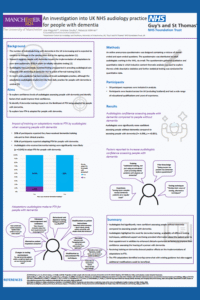
- An investigation into UK NHS audiology practice for people with dementia – presenter Lisa Maguire
- How do Audiologists enhance hearing aid compliance in younger adults – presenter Jynika Ramji
- The UK National Eye Health and Hearing Study (UKNEHS) – presenter Carolina Leal
- Investigating the agreement between 4kHz ABR and PTA thresholds – a review of the data used to inform the BSA guidelines – presenter Helen Brough
- Exploring the burden of “work” in the paediatric cochlear implant assessment process – presenter Marette Ambler
- Hearing Better Reducing waiting times in Audiology – presenter Reena Patel
- Audiovestibular symptoms of Posterior cranial fossa arachnoid cyst – presenter Sk Mamun Ur Rashid
- Preliminary Trends Observed following Cochlear implantation of children with either ANSD or Hypoplastic nerves or with both conditions – presenter Marsha Jenkins
- Is there a cochlear phenotype for Neurofibromatosis type2 related schwannomatosis – presenter Shada Nassar
- A pilot study of individual management plans for cochlear implant recipients – presenter Susan Boon
- Effectiveness of implementing a joint audiologist led ENT clinic for the management of glue ear – presenter Eleanor Brown
- Why Set Childrens Hearing Aids this way_Jodie Nelson 65. Noise Control algorithm reduces listening effort for adolescents – presenter Jodie Nelson
- Noise Control algorithm reduces listening effort for adolescents – presenter Jodie Nelson
- Its Complicated Unexpected Findings and Expected outcomes for microsuction – presenter Lee Fox
- Implementation of ototoxicity monitoring guidance in an NHS setting – presenter Eleanor Addison
- The ‘real-life’ benefits of hearing preservation cochlear implantation in the paediatric population – presenter Yuhan Wong
- Cochlear Histology in Alport Syndrome – presenter Jai Shikotra
- Noise exposure and risk to hearing in professional practice and leisure activities from balloon pops – Luis Gomez Agustina
2023 BAA Conference Posters
- A qualitative study to understand the illness and treatment burden of hearing loss across the life course
- Bone-conducted cVEMPS – NHS applications
- Evaluating the Perceptions of Preceptorship for Healthcare Science
- Estimating the prevalence of hearing loss in people with dementia: Protocol for a feasibility study
- Integrating Auditory Steady State Response (ASSR) testing into the Paediatric Assessment Pathway: Sharing our Experience
- Clinical Audit of 8 Month Visual Reinforcement Audiometry (VRA) Appointments
- Managing mild permanent childhood hearing impairment identified through the newborn hearing screening programme
- Effects of Sleep, Age, and Hearing on Ease and Effectiveness of Communication, and the Role of Cognitive Resources
- The development, utilisation and benefits of discharge criteria in paediatric audiology
- Audiology Clinician Perspectives on Decision-Making for the Management of Otitis Media with Effusion: A Thematic Analysis
- Paediatric Tinnitus & Hyperacusis Clinical Outcomes: Assessing Efficacy and Treatment Implications
- The development and validation of a patient reported experience measure (PREM) for people with hearing loss: the PREM-HeLP
- Time for change! Developing a sustainable pathway to reduce patient waiting times within the balance service.
- Children’s Hearing Services Working Groups Capturing young peoples views as they transition to adult services: National Deaf Children’s Society Moving On Survey
- The BSA Auditory Steady-State Response Guidance in Clinical Practice: results from correlations with Auditory Brainstem Response at 1kHz
- Validation of browser-based Arabic Digits-In-Noise tests, including comparisons of diotic and antiphasic versions
- VEMPlitude: Is It Worth It?
- The UK Cochlear Implant Referral Criteria Audit (CIRCA): Socioeconomic and ethnic disparities associated with access to cochlear implantation for severe–to–profound hearing loss: a multicentre study of 6,236 UK adults
- The experience of Tinnitus UK and their development of Axel, a chatbot for tinnitus support
- A lot to lose: noise exposure and tinnitus in a patient group
- Using data from the NHS Newborn Hearing Screening Programme national IT system to inform screening & audiology quality improvement initiatives
- The clinical experiences and opinions of healthcare professionals regarding the audio-vestibular consequences of individuals with traumatic brain injury
- Primary Care Audiology: What can be learnt from other roles in Primary Care?
- A qualitative study to understand the illness and treatment burden of hearing loss across the life course
- Evaluation of masseteric vestibular evoked potentials in patients with migraine
- The liaison role The missing link for the Children’s Hearing Service
- The effect of occupational exposure to noise and chemical agents on hearing abilities
- Implementation of Quality Standards for Vestibular and Tinnitus Services in Wales
- Retrospective analysis of ear choice, and the effect on outcomes in adult unilateral Cochlear Implant (CI) recipients
- Generating priorities for future dementia and hearing research: A James Lind Alliance Priority Setting Partnership
- Testing the feasibility of creating a Tinnitus Biobank
- Developing student engagement within the oral presentation assessment process
- Shared-decision making – Student Audiology Perspectives
- Alternative Authentic Assessments: Developing Healthcare Professionals
- Age related hearing loss – it’s not routine
- Childhood deafness: whose experience is it anyway!
- The Role of a Clinical Research Practitioner in improving quality and efficiency in the delivery of clinical hearing research
- Diagnostic yield of identifying a genetic cause of hearing loss in children after the introduction of the Next Generation Sequencing Panel R67 gene panel for monogenic hearing loss
- Children with developmental dyslexia demonstrate atypical speech production for multisyllabic words and phrases
- Don’t touch me! A child/young adult led approach to desensitisation.
- An investigation of the effectiveness of remote microphone technology for hearing aid users
- Investigating the Family and Child’s Experience of Microtia and Hearing Loss
- Audit into Outcomes Relating to a Primary Care Audiology Pilot in Cardiff and Vale University Health Board
- An update on the COACH trial (COmpAring Cochlear implants with Hearing aids in adults with severe hearing loss) and how it might benefit your adult hearing aid patients
- Health inequalities: Improving the reach and impact of the RNID hearing check
- AUDITORY PHENOTYPE OF INDIVIDUALS WITH INFRATENTORIAL (CLASSICAL) SUPERFICIAL SIDEROSIS: A CROSS-SECTIONAL STUDY
- Hearing Rehabilitation of Adults with Auditory Processing Disorder (APD): A Systematic Review and Meta-analysis of Current Evidence-Based Interventions
- A CROSS-SECTIONAL STUDY OF VESTIBULAR CHARACTERISTICS OF INDIVIDUALS WITH INFRATENTORIAL (CLASSICAL) SUPERFICIAL SIDEROSIS
- How good are audiologists at otoscopy?
- The Validation of the Newly Recorded AB Word Test Stimuli on Real Cochlear Implant Users
- Objective measures of human temporal resolution with ABR – A preliminary study
- The impact of idiopathic Sudden Sensorineural Hearing Loss on patients’ Quality of Life
- Capturing information on childhood hearing loss diagnosed after 6 months in England for congenital CMV research: use of the Newborn Hearing Screening Programme (NHSP) national IT system (S4H)
- Developing a questionnaire for children with hearing loss – the York Binaural Hearing Related Quality of Life – Youth (YBHRQL-Y)
- Spinning as a Form of Vestibular Rehabilitation
- Comparative Analysis Of Auditory Profile Of Individuals With Infratentorial Superficial Siderosis And With AgeRelated Hearing Loss Using Patient-Reported Outcome Measures: A Case-Control Study
- Barriers to the inclusion of underserved groups in research about co-existing dementia and hearing conditions
- Establishing normative data for horizontal and vertical random saccades using videonystagmography (VNG) and exploring correlations between age and saccade parameters.
- Professional opinions of radio aid provision for deaf babies and toddlers
- Understanding barriers and facilitators to hearing aid use in children under 3 years of age: Using behaviour change theory to inform intervention development
- Follow-on impact from memory screening in older adults attending NHS hearing aid assessment appointments: a pilot study
- The Validation of Newly Recorded AB Word Test Stimuli on Real Cochlear Implant Users
- A feasibility study assessing physical health outcomes in hearing aid users
- Earmould-induced allergic contact dermatitis leading to novel earmould material: A case study
- Clinical and sociodemographic predictors of hearing aid use in infants aged 0-2 with permanent childhood hearing loss: a retrospective cohort single-site pilot study
2022 BAA Conference Posters
Clinical Posters
- Case study of sudden onset bilateral auditory, visual and vestibular neuropathy
- The New BSA ASSR Guidance in Practice
- Vestibular Dysmorphia and Cochlear Hearing Impairment in Down’s Syndrome
- Do hearing aid users prefer hearing aids fitted with or without real-ear measurements
- Evaluation of North Wales Cochlear Implant Remote Check Service Including Service User and Clinician Feedback
- Investigating the use of a GN Multi Microphone within a classroom setting and daily life for children with longstanding hearing loss
- Deaf Awareness, Accessibility and Communication in the NHS How can we do better
- Implementing Medical Devices Training and Monitoring in an NHS Audiology Service.
- Estimates of interaural attenuation in children and the implications for masking in clinical audiometry
- Endolymphatic hydrops in children
- A Novel Tool for Cerumen Removal the EarWay Pro – Results of Clinical Assessments by Audiologists
- Audiological Profile of Recovered SARS-COV-2 Patients
- Assessment of the vertical semi-circular canals using vHIT preservation of anterior canal function in patients with
- Impact of COVID-19 on Newborn Hearing Screening Programme in a large teaching hospital
- Examining speech recognition with the use of adaptive gain receivers and ReSound Multi Microphone technology
- Evaluating the Effectiveness of Using Different Algorithms per Ear with Bimodal Solutions
- Newborn diagnostic auditory assessment from NHSP during COVID lockdowns in England
- An Evaluation of the Cochlear BAHA 5 SuperPower (BAHA5SP) and Power Bone Anchored Hearing Devices (PBAHD)
Education Posters
- Atypical Audiovestibular presentation in connexin 26 mutation variants
- Advancing tinnitus research and researcher training a case study review and future perspectives
Research Posters
- Datalogging findings in adult cochlear implant recipients who never developed intelligible speech
- Who’s here for Glue Ear
- Questionnaire screening for BPPV in adults referred to a direct referral balance clinic
- Co-Developing a Psychological Support Package for People with Vestibular Conditions
- The use of auditory evoked potentials in people with learning disabilities A scoping review summary
- A pilot study exploring clinician’s decisions to implement video consultations for vestibular rehabilitation.
- An Exploratory Study Identifying a Possible Response Shift Phenomena of the Glasgow Hearing Aid Benefit Profile
- What can my hearing aids do
- Outcomes of a fully-remote clinical pathway adapted for NHS
- Click vs CE-Chirp ABR in relation to pure tone thresholds in Adults with Normal Hearing and Sensorineural Hearing Loss
- Potential inflammatory biomarkers for tinnitus in platelets and leukocytes a critical scoping review and meta-analysis
- Auditory Training an app with Noise
- Attitudes towards hearing healthcare hearing aids and hearables amongst adults
- Decreased Sound Tolerance in Autism Spectrum Disorder A Scoping Review
- Does the configuration of a mild hearing loss effect the benefit received by adults fitted with bilateral hearing aids
- Music-listening Level Preferences in Musicians and Non-Musicians
- Developing Strategic Directions for Inclusive Research about Co-existing Dementia and Hearing Loss in Consultation with Key Stakeholders.
- Using the qualitative pre-test interview to develop a questionnaire for children with hearing loss
- Adaptation and Validation of the YBHRQL-Y a preference based measure for children with hearing loss
- Barriers and facilitators to conducting tinnitus trials in the UK audiology departments an example of the HUSH trial
- Hearing aid outcomes assessed using Ecological Momentary Assessment (EMA)
- How should we define and measure hearing aid use success Perspectives of adults who have hearing aids and hearing healthcare professionals
- Investigating the influence of hearing loss and hearing aid use on emotional states in everyday listening situations using
- How’s what sound Perceptual shortcomings in current hearing-aid personalisation
- Barriers and Facilitators to Providing Hearing Healthcare to People with Dementia Living in Long-Term Care Interviews with Care Staff
- Coproduction of text message content to support NHS audiology patients when they are first prescribed hearing aids
- Hearing Loss and Patient Reported Experience (HELP) Using patient experience to improve audiology
- What is the burden of tinnitus
- Practice Listening and Understanding Speech (PLUS) Feasibility of providing auditory-cognitive training alongside hearing aids in the NHS
- Verbal and non-verbal auditory sequential memory test Performance of an app
Service Innovation Posters
- Everything will be okay
- Supporting staff with hearing loss
- Remote Triage appointments for vestibular patients during COVID and beyond. Streamlining the patient pathway to facilitate best
- Audiology assessment for children and young adults with complex needs; The journey to a bespoke audiology suitE
- Experience in Audiology with using patient informed choice for MRI requests
- HAs in the CI department – The smart alliance
- Prudent Health Care in practice Integration of Audiology services into Primary Care
- Option to reduce ABR Referral Rates from NHSP
- Organising Departmental Service Improvement in practice using the project management tool Trello
Workforce Posters
We welcome submissions from audiologists, hearing healthcare professionals, researchers, students, and multidisciplinary colleagues at all career stages.
We no longer have set categories, and welcome submissions in Adult Diagnostics & Rehabilitation, Paediatrics, Tinnitus & Balance, Education & Training, Service Development, Research & Innovation, Professional Issues and more.
-
Title: Clear and concise (max 20 words)
-
Authors & Affiliations: Include full names and organisations
-
Word Limit: Max 300 words (excluding title and references)
-
Structure:
-
Background/Aim
-
Methods
-
Results
-
Conclusion/Implications
-
✔ Use plain language – avoid excessive jargon
✔ Ensure data is clear and supports your conclusions
✔ Indicate clinical relevance or innovation
✔ Proofread for clarity and grammar
-
Oral Presentation (15 mins)
-
Poster Presentation
The committee may offer an alternative format to ensure the best fit for the programme.
All abstracts are anonymised and reviewed by the BAA Programme Committee. Selection is based on quality, relevance, and clarity.
Deadline for submissions is 31st July 2026.
The portal closes on this date and late submissions will not be accepted.
Use the official online submission portal at: Oxford Abstracts Portal
Contact: conference@baaudiology.org
Thank you to our 2026 Official Sponsors
